Challenge Coin Stearman 75-8291
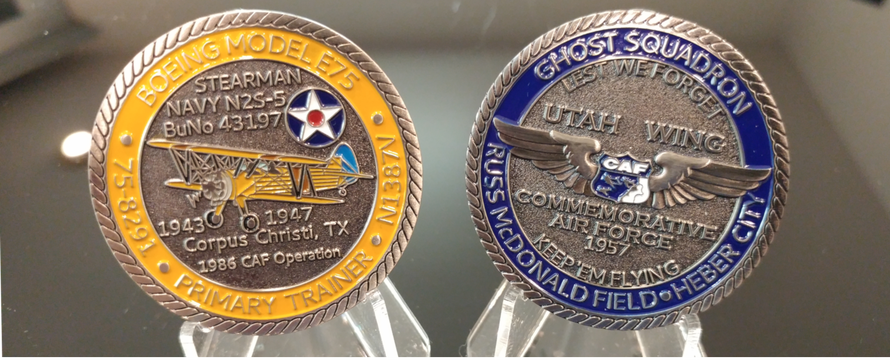
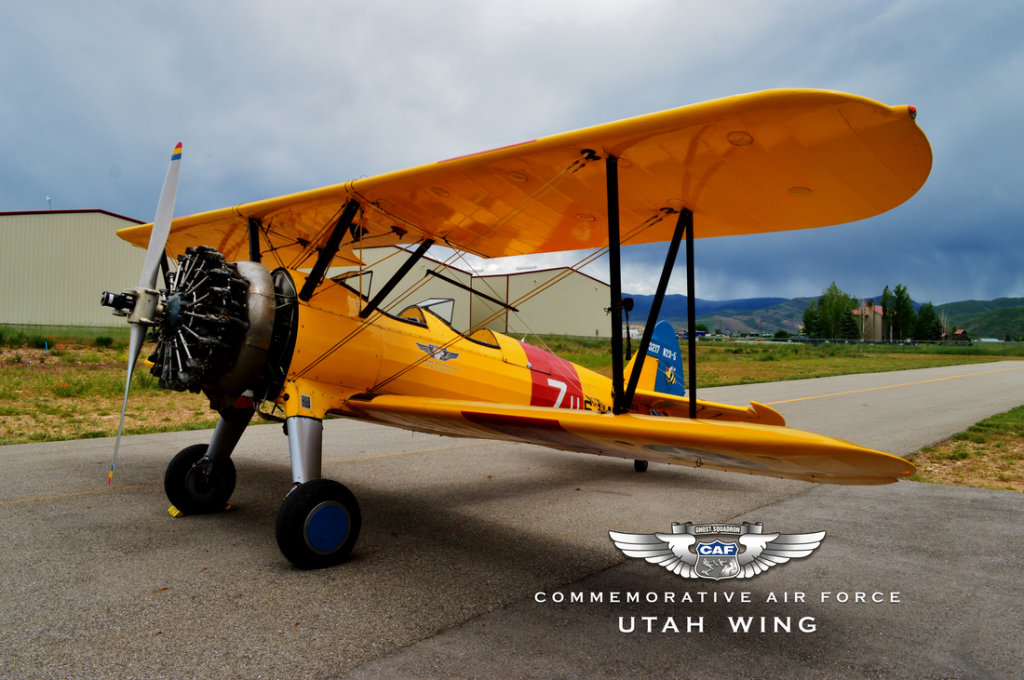
The challenge coin featuring the Stearman 75-8291 displays details of significance not only of this specific Stearman, but also of the Commemorative Air Force Utah Wing. Carry or display it as a token of more than 75 years of flying history and the starting point of U.S. military pilots that went on to shape the history of the world.
Obverse / Front
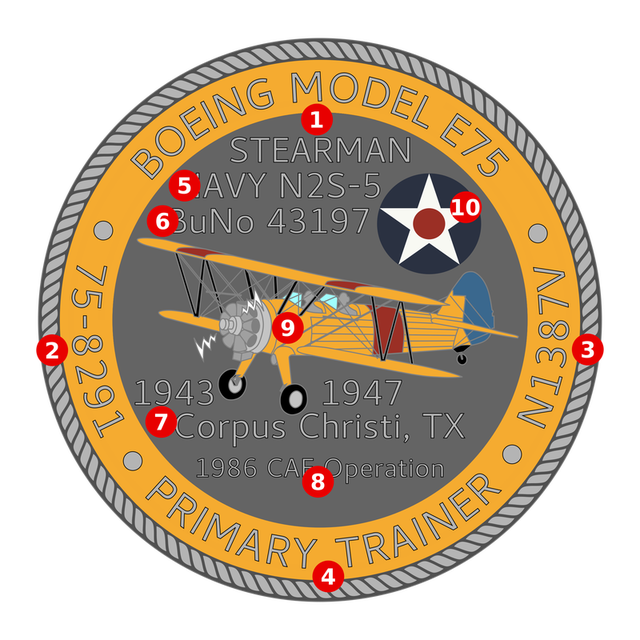
(1) Boeing Model E75 / Stearman
The Boeing Model E75 was a fabric-covered, tandem, bi-plane. It was designed and built by the Stearman Aircraft Corporation, located in Wichita, Kansas that became a subsidiary of Boeing. Although Stearman Aircraft Corporation built several models of aircraft, the most successful was the the Model E75 which was often referred to as simply the Stearman.
The Boeing Model E75 was adopted by both the United States Army Air Corps and the United States Navy for use as a primary trainer. The Army operated variants of the E75 as the PT-13, PT-17 and PT-18 while the Navy operated the same variants as NS and N2S. Other Countries also operated the Model E75 including the Royal Canadian Air Force which referred to it as the Kaydet – a name that was adopted by Boeing.
The Wichita plant built over 8,000 Model E75s with sufficient spare parts to build an additional 2,000 aircraft. The National Museum of the United States Air Force consequently lists the manufactured number as 10,346. Due to the large quantity of aircraft sold at surplus prices after World War II, the Stearman became a popular aircraft for agriculture and aerial spraying.
(2) 75-8291
This challenge coin specifically commemorates the Stearman operated by the CAF Utah Wing – specifically Boeing number 75-8291 (this was referred to as a construction number or “C/N”).
At the outset of World War II aircraft purchase orders assigned both USAAF serial numbers (“S/N”) as well as Navy Bureau of Aeronautics numbers (“BuAer No” or even “BuNo”) to aircraft purchases. In 1942 750 Model 75s – specifically N2S-5s – were ordered for the Navy with Army-assigned S/Ns of 42-109026 – 42-109775. Boeing C/N 75-8291, corresponding to USAAF S/N 42-109258, was completed on August 11, 1942 and delivered to the Naval air station of Corpus Christi, Texas.
(3) N1387V
After four years of service at Corpus Christi, Texas Naval Air Station, Stearman 75-8291 was sold as surplus to Marshall D. Odell of Baltimore, Maryland. 75-8291 was registered with the Civil Aeronautics Administration (Later the Federal Aviation Administration) and given a tail number of N1387V.
N1387V served many years with multiple agricultural companies. To improve performance and payload for spraying the original Lycoming R-680-17 rated at 225 hp was replaced with a Pratt & Whitney R985-14B rated at 450 hp.
(4) Primary Trainer
For service in the military the Stearman was designed as a trainer to be easy to fly, yet require focused attention so that lesser pilots would “wash out”. The bi-wing with landing wires, flying wires, struts and braces made the Stearman robust to withstand abuse from cadets.
The fuel tank was located in the center section of the top wing which created a high center-of-gravity. This high center-of-gravity gave the Stearman a propensity to “ground loop” if not vigilantly controlled throughout landing until a complete stop.
Most Stearmans had minimal gauges and were only qualified for visual flight conditions. Stearmans with navigation instruments were often designated with broad bands around the fuselage and wings. Initially bands were red, but when the red dot was removed from the roundel in 1942 the green bands took the place of red. Stearman 75-8291 is painted as a yellow peril with a red band scheme.
Stearmans lacked radio equipment. Specially-painted Stearmans with a barber-pole scheme were designated “recall” planes. When sent aloft they were an indication to the cadets to return to base.
(5) Navy N2S-5
Stearman 75-8291 was delivered to the Navy as an N2S-5. This was the designation for a Stearman powered by a Lycoming R-680-17 engine. A total of 1,450 N2S-5s were delivered to the U.S. Navy. The equivalent Stearman configuration was designated a PT-13D when delivered to the Army Air Forces. Other engines were also used: Wright J-5 Whirlwind (NS, Navy), Continental R-670 (PT-17, Army), Jacobs R-755 (PT-18).
Reverse / Back
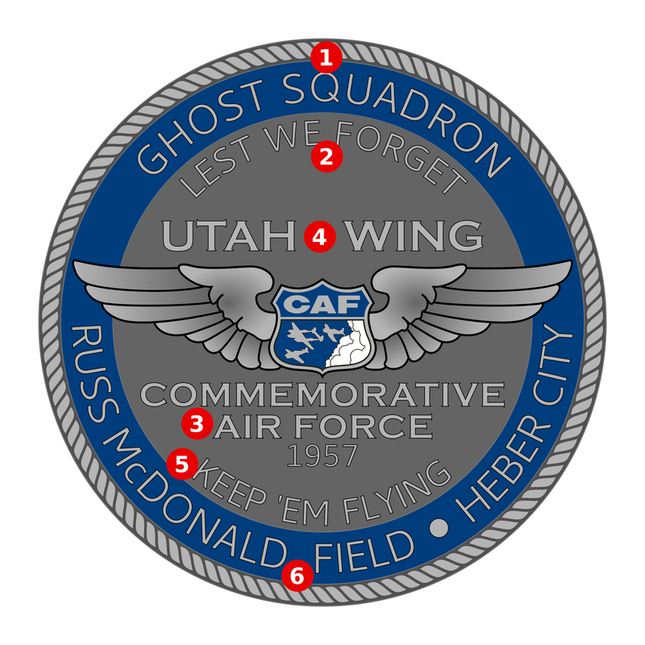
(1) Ghost Squadron
The Commemorative Air Force refers to its historic fleet of aircraft as “Ghost Squadron”. As of 2018 it has grown to 171 aircraft with approximately 90% operational comprised of fighters, bombers, trainers, transports and liaison aircraft.
(2) Lest We Forget
The phrase, “lest we forget,” has been a common remembrance through modern history – possibly originating with Rudyard Kipling in his 1897 poem Recessional (first stanza):
God of our fathers, known of old,
Lord of our far-flung battle line,
Beneath whose awful hand we hold
Dominion over palm and pine–
Lord God of Hosts, be with us yet,
Lest we forget—lest we forget!
The phrase is now commonly used with war remembrance and commemorative services.
(3) Commemorative Air Force 1957
In 1957, a small group of ex-service pilots pooled their money to purchase a P-51 Mustang, beginning what is now called the Commemorative Air Force. With the addition of a pair of F8F Bearcats, the CAF became the founders of the warbird movement, an effort to preserve and honor our military history.
(4) Utah Wing
The Commemorative Air Force unit operating in Utah is known as the Utah Wing. It replaced a previous CAF unit when it merged with Heber Valley Aero Museum which had been established May 25, 2002.
(5) Keep ‘Em Flying
The official motto of the U. S. Army Air Corps was “Keep ‘Em Flying.” It was coined on May 17th, 1941 by Lt. Col. (later Maj. Gen.) Harold N. Gilbert. It accompanied recruitment ads for the Aviation Cadet Program and successfully entered the public parlance and was even the title of a 1941 movie starring Abbott and Costello.
(6) Russ McDonald Field • Heber City
The Commemorative Air Force Utah Wing operates from Russ McDonald Field, Heber City, Utah.
Russ McDonald was a founding partner in Heber Valley Flying Service, Inc. – which, in 1947, built the first hangar and graded the first runway in the land Heber City had set aside for a municipal airport.
The airport has grown from the original 3,300′, graded runway to a 6,900′ paved runway with multiple rows of hangars and a broad range of operations of personal aircraft to small business jets. It is current known as *Heber Valley Airport – Russ McDonald Field*.
75-8291 Manufacture Date
The manufacture date of Stearman 75-8291 has conflicting dates:
Boeing employee, Michael J. Lombardi, Chief Company Historian, responded to a query with the following:
May 10, 2018
Hi Thayne,
Unfortunately the folks at Wichita did not keep delivery logs so I cannot get an exact date but I do have serial number records that show a range of dates between June and November 1943 for those three blocks of the E-75 (750 airplanes). Averaging out the production does put your plane somewhere near the very end of July or first half of August so the date of August 11, 1943 does appear to be correct.
Cheers,
Mike
Navy bureaus tracked assets with records that were archived even after the asset was destroyed or sold. The air history card for BuNo 43197 was obtained from the Smithsonian Institute. It shows an acceptance date of “8-14-43” and a delivery date of “8-18-43” which closely align with the information from Mr. Lombardi of Boeing and the manufacture date of “8-11-43” mentioned in the Ferry Permit.
n1387v WAA Sales Document (PDF)
Smithsonian BuNo 43197.2 (PDF)
Challenge Coin History
The challenge coin has been part of U.S. military culture for a hundred years … maybe:
The History of the Challenge Coin
The Challenge Coin Tradition: Do You Know How It Started?
It has now developed additional details: